AI Voice Adoption Surges as 55% of Enterprises Deploy Agents
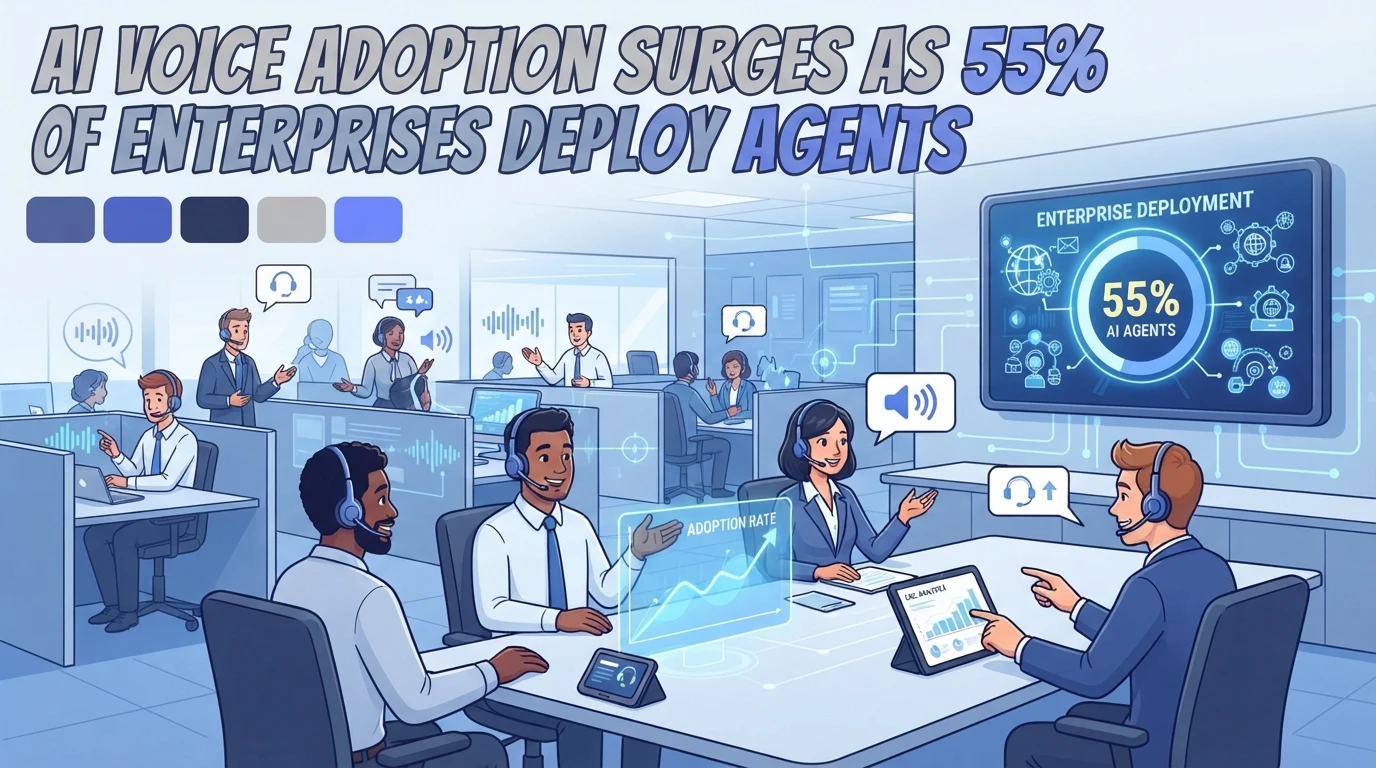
Quick Summary: Fifty-five percent of enterprises now run AI voice agents in production, and 92% plan to expand within two years, per the 2026 AVOXI and Metrigy report. Big platforms like ElevenLabs, Voice.ai, and Weave price per minute or per seat for large teams, leaving small shops with unpredictable bills and developer-heavy setup. The practical move for a single-location business is a flat-rate agent that answers under a second, books appointments directly, and needs no API keys.
Fifty-five percent of enterprises now run AI voice agents in production, and 92% plan to deploy or expand them within two years. That is the headline from the State of International Voice for the Contact Center Report, released September 29, 2026 by AVOXI and Metrigy. For small business owners still leaning on voicemail or one receptionist, the gap is growing fast. This piece breaks down the top business voice automation platforms side by side, so you can match call volume, budget, and integrations to the right tool.
Enterprise Adoption Has Crossed the Tipping Point
Most enterprises no longer treat AI voice as an experiment. The Metrigy and AVOXI survey of contact center leaders found that 94% are already using or evaluating AI for voice, and improving how customers perceive the brand is now the top driver, not cutting headcount. The full survey data lives on ContactCenterWorld.
Augmentation, Not Replacement, Dominates 2026 Use Cases
The dominant pattern in 2026 is human plus agent, not agent instead of human. Teams deploy business voice automation for routine work: answering overflow calls, handling after-hours requests, and capturing details before a person picks up. Live agents keep the judgment calls, the upset callers, and the nuanced sales conversations. The Yahoo Finance coverage of the report frames it the same way: mainstream adoption raises the bar on voice quality, security, and orchestration rather than shrinking teams. For small businesses, that is good news. An AI voice agent that books appointments and handles the front desk’s routine calls lets one or two people cover what used to require three.

The Geographic and Provider-Sprawl Gap
Big companies still struggle with coverage. Among multinationals, 59% use six or more voice providers, which fragments quality, security, and reporting. Provider consolidation is one of the report’s central themes, because every extra vendor adds another point of failure. Business voice automation only works when calls, calendars, and customer records stay in sync, so sprawl is a warning sign for buyers of any size. Small businesses rarely need six providers, but they face the same risk in miniature when they bolt together separate tools for calls, booking, and follow-up.
How Popular AI Voice Agent Platforms Compare
The enterprise market has standardized on big platforms, but their pricing and design favor large teams. Here is what small businesses actually pay and what they give up.
Pricing and Latency at a Glance
ElevenLabs is the best-known name, and it charges about $0.08 per conversation minute for its agents, plus the cost of the underlying language model and phone service according to Cartesia’s pricing breakdown. That per-minute model makes sense for software teams building agents into their own products. For a salon taking 400 calls a month, it adds up fast, and you still have to design the call flow, connect telephony, and tune response delay yourself.
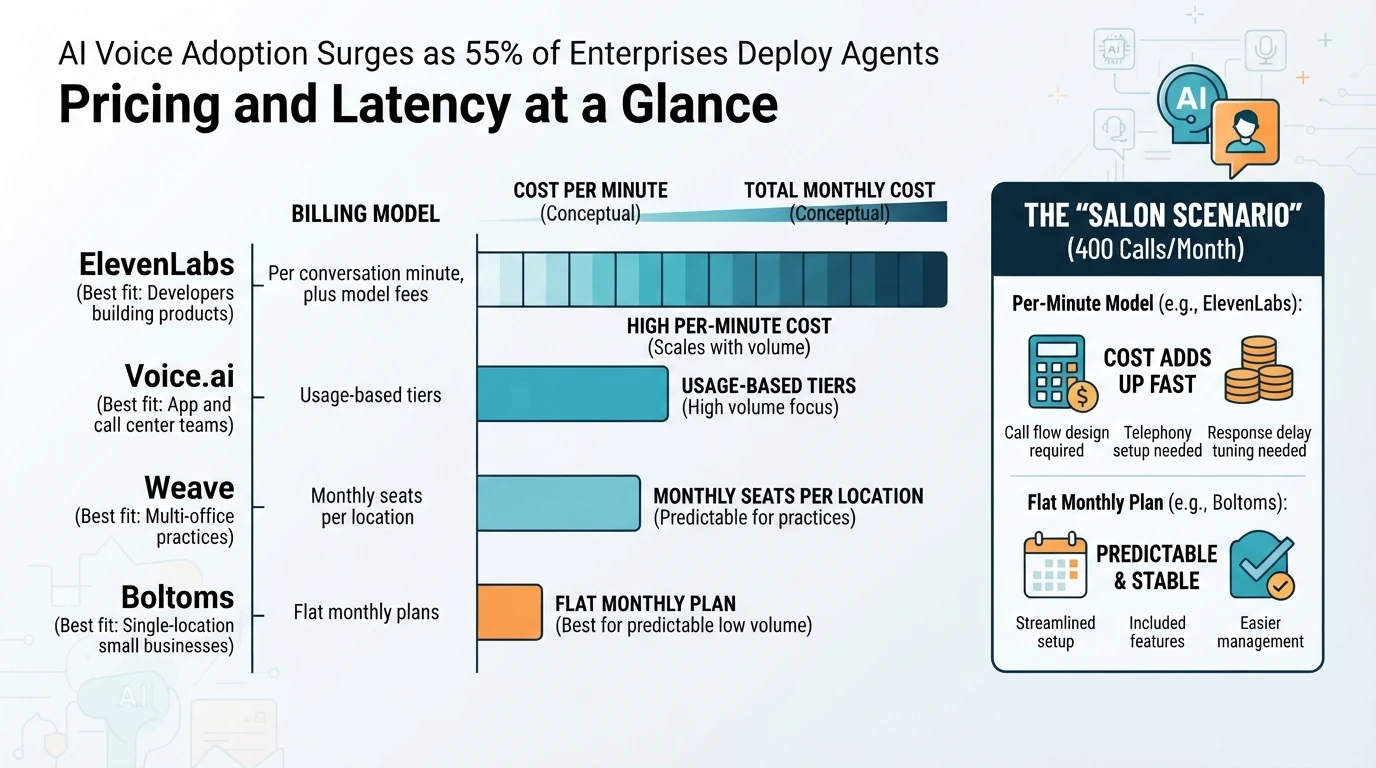
Other enterprise-focused platforms, including Voice.ai and Weave, follow similar patterns: usage-based billing or monthly seats priced for multi-location organizations. Latency varies too. Flash and turbo models answer in well under a second, but they trade some naturalness for speed, so callers can hear the difference.
| Platform angle | Billing model | Best fit |
|---|---|---|
| ElevenLabs | Per conversation minute, plus model fees | Developers building products |
| Voice.ai | Usage-based tiers | App and call center teams |
| Weave | Monthly seats per location | Multi-office practices |
| Boltoms | Flat monthly plans | Single-location small businesses |
What Small Businesses Should Look For Instead of Enterprise Features
Enterprise platforms sell developer tools, custom models, and multi-provider routing. You don’t need six voice providers when one line rings your shop. What matters at your scale is simpler.
- Answer speed. If the agent pauses more than a second, callers hang up.
- Booking that actually happens. The agent should update your calendar or CRM, not just take a message.
- A setup you can describe in plain English. No flowchart builder or API keys.
- Predictable cost. A flat rate beats a per-minute bill that spikes with your busiest month.
A good reference point is our AI phone answering service guide, which walks through exactly these criteria. Pick the platform that answers, books, and costs the same every month.
Big enterprises are moving fast, but your shop can too. Boltoms sets up custom AI voice agents for you, so every call gets answered and booked. See how it works at Boltoms.
Frequently Asked Questions
Q1: How do popular AI voice agent platforms compare?
ElevenLabs bills per conversation minute (about $0.08 plus model fees), fitting developers. Voice.ai uses usage tiers, Weave charges monthly seats per location, and Boltoms offers flat monthly plans built for single-location small businesses.
Q2: What does an AI voice agent cost a small business per month?
It depends on the model. Per-minute pricing scales with call volume, while flat monthly plans stay predictable. A salon taking 400 calls a month often pays less on a flat rate than on per-minute billing.
Q3: Will an AI voice agent replace my receptionist?
No. The dominant 2026 pattern is augmentation: the agent handles overflow, after-hours, and routine calls, while people keep judgment calls and nuanced conversations.
Q4: How fast should an AI agent answer?
Under a second. Flash and turbo models respond quickly but can sound slightly less natural. If callers hear a noticeable pause, many hang up.
Conclusion
Enterprise adoption has tipped, but the tools winning that race aren’t built for small shops. Per-minute billing and developer-heavy setup favor big teams. For a salon, clinic, or agency, the better pick answers in under a second, books directly, and bills one flat monthly rate. If you want a fuller rundown of options, our AI phone answering guide covers them.
Output Assignment (Normalized)
This run contains one or more finalized output sections that are produced by the instruction pipeline. The table below normalizes each section into its canonical run-level constraints so it can be diffed directly against the generated content.
Normalized Output Assignments
| Field | Value |
|---|---|
| Section title | Conclusion |
| Article title | AI Voice Adoption Surges as 55% of Enterprises Deploy Agents |
| Section type | conclusion |
| Audience | U.S. small business owners and appointment-based service providers evaluating AI voice platforms |
| Language | English |
| Target length | ~38 words (hard max 62) |
| Must include | Summary of key takeaways |
| Must not include | Call-to-action, “Next Steps” |
| Internal links | Up to 1 (2 of 3 already used in article) |
Keep reading
All posts
9 Best Small Business Answering Services After Hours in 2026
Read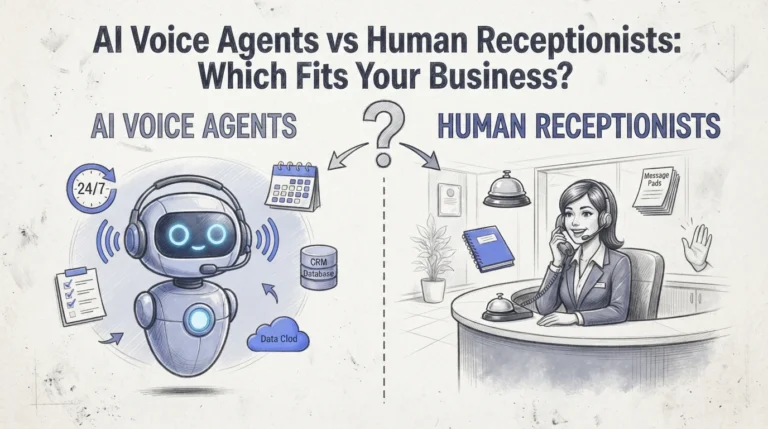
AI Voice Agents vs Human Receptionists: Which Fits Your Business?
Read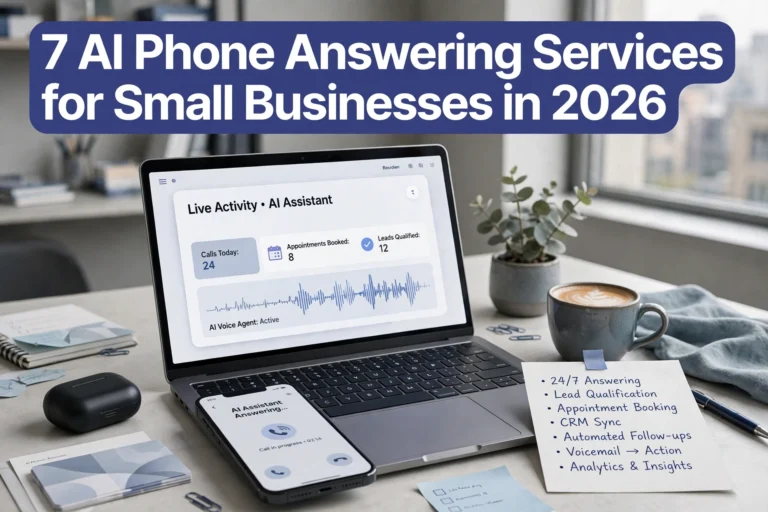
7 AI Phone Answering Services for Small Businesses in 2026
ReadYour next caller gets an answer.
Call the demo line and talk to a Boltoms agent, or book a 20-minute demo built around your business.