What happens to the calls you don’t answer
A missed call rarely waits for a callback. Here’s where those callers go, what it costs a small business, and a simple way to find out how many you’re missing.
Every small business owner knows the feeling: you finish a job, check your phone, and there are three missed calls from numbers you don’t recognize. Maybe one left a voicemail. The other two didn’t.
It’s tempting to think of those as calls you’ll “get back to.” In practice, most of them are already gone.
Callers don’t wait. They dial the next number.
Someone searching for a plumber, a dentist or a photo booth for Saturday usually has a short list open on their phone. If the first business doesn’t pick up, the easiest next step isn’t leaving a message. It’s tapping the next result. By the time you call back, they’ve booked with whoever answered.
That’s why a missed call costs more than it looks. It isn’t one lost conversation. It’s the job that came with it, plus everything that customer would have spent with you afterwards.
Where the missed calls come from
Most businesses don’t miss calls because they don’t care. They miss them because the phone rings at the worst possible moments:
- While you’re with a customer. You can’t stop a cleaning, a showing or a repair to answer.
- After hours. Evenings and weekends are when many people finally have time to make the call.
- At rush hour. Two lines ring at once and one goes to voicemail.
- On days off. Holidays, sick days, and the front-desk person’s lunch break.
Voicemail isn’t a safety net
Voicemail feels like a backup, but it puts all the work on the caller. They have to decide to leave a message, remember the details, and trust that you’ll call back soon. Many won’t. And the ones who do still have to wait, while your competitors are a tap away.
The question isn’t whether you’re missing calls. It’s how many, and when.
A 10-minute missed-call audit
You don’t need special software to see the problem. Open your phone or your phone provider’s call log and look at the last two weeks:
- Count the calls that went unanswered.
- Note what time each one came in. Look for patterns: lunchtime, evenings, Saturdays.
- Check how many of those callers left a voicemail.
- Check how many you actually called back, and how long it took.
- Ask yourself what one booked job is worth to you, and multiply.
Most owners who do this are surprised, not by the total, but by how many missed calls land at the same few times every week.
What answering every call looks like
An AI voice agent picks up on the first ring, any time of day. It answers common questions, books the appointment into your calendar, takes the details you need, and texts a confirmation. When a caller needs a person, it can transfer the call, take a message and text it to you, or book a callback.
You keep doing the work in front of you. The caller gets an answer instead of a voicemail greeting.
Want to hear what that sounds like? Call our demo line at (734) 391-1914 and talk to a Boltoms agent, or book a 20-minute demo built around your business.
Keep reading
All postsHow an AI voice agent books an appointment, step by step
Read
AI Voice Agents vs Human Receptionists: Which Fits Your Business?
Read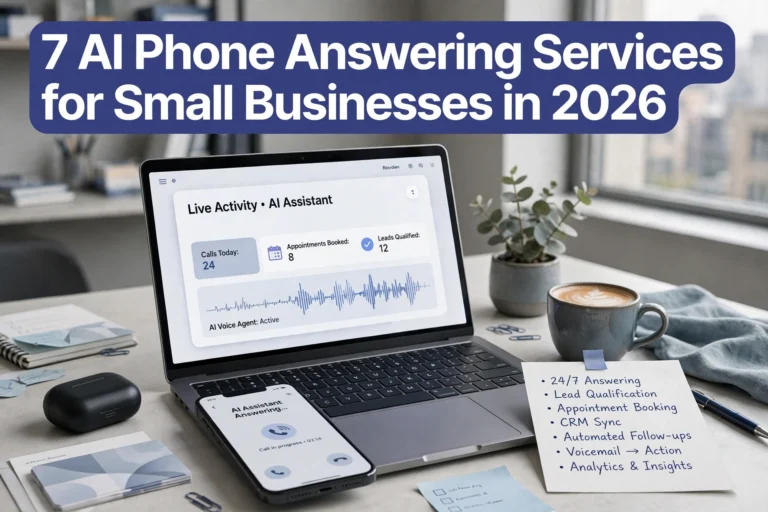
7 AI Phone Answering Services for Small Businesses in 2026
ReadHear it for yourself
Your next caller gets an answer.
Call the demo line and talk to a Boltoms agent, or book a 20-minute demo built around your business.